CONTACT |  info@brewup.eu

SEARCH

580 results found for ""

Total sulphur dioxide in beer by DTNB method with quick test kits (IM)

The purpose of this method is the determination of total sulphur dioxide in beer. Sulphites, like sulphur dioxide, are a group of sulphur-based substances which are produced naturally during fermentation and are also used as food additives for their preservative and antioxidant properties. This method describes the determination of Total Sulphur Dioxide in beer using DTNB method with quick test kits a) CDR BeerLab®, b) Merck Spectroquant, c) Megazyme K-TSULPH of Neogen. The method is based on the reaction between sulphur dioxide and 5,5’-dithiobis nitrobenzoic acid (DTNB) in basic conditions. The absorption is measured on a photometer of the supplier (CDR BeerLab®) or a spectrophotometer (Spectroquant or Megazyme test). The method has been validated to cover a total sulphur dioxide range of 1,0 to 19,4 mg/L.  Basic laboratory skills, including pipetting skills, are sufficient to accomplish the semi-automated (CDR BeerLab®) or manual (Spectroquant/Megazyme) method successfully, the beer samples should be briefly degassed. Labour time and total analysis time are short; within 1 hour (CDR BeerLab®/Megazyme) the results can be reported of a few samples; for Spectroquant you need 1 to 2 hours. The reagents used do not present a specific risk, however you need to wear safety gloves and glasses when you work with reagent 1 (SO3-1) of Megazyme.

  • 29/06/2026

EBC Symposium 2025 – Registration now open

Join us from 18 to 20 May 2025 in Budapest, Hungary, for a deep dive into Sustainable Packaging for Beer – Innovations in Keg & Tank-Beer Installations, Beer Dispense Technology & Quality

  • 31/03/2025
  • news

Safety Instructions

This set of safety instructions should be read before the use of any Analytica EBC Methods. The safety instructions specific to each method are detailed in the individual method's protocol. These safety instructions have been drafted by Campden BRI upon request of The Brewers of Europe/EBC (which produce a series of analytical methods that breweries and their related laboratories can follow to achieve consistent and reproducible results) and are aimed to provide some safety statements covering the general practices to be followed in a laboratory to achieve a safe and productive working environment. These statements are not intended to replace any existing national or supra-national legislation, standards or guidance. It is recommended that these statements are used in conjunction with existing guidance. A selection relevant to an international audience is provided in the Appendix.

  • 30/10/2024

Detection of Saccharomyces Cerevisiae var. diastaticus

Detection of Saccharomyces cerevisiae var. diastaticus in samples of brewers' yeast, fermenting, filtered and packaged beer and the production environment including water, swabs and air.

Descriptors: Saccharomyces cerevisiae var. diastaticus, super attenuation, over carbonation, spoilage, wild yeast, PCR.

  • 15/04/2024

Method to measure Congress Mash wort turbidity

This procedure is used for the determination of turbidity of congress mash wort. An adapted mashing regime is proposed to ensure complete starch saccharification when it is not complete with standard congress mash. In particular, it could be used to measure wort turbidity of malts with high starch gelatinization temperatures.

  • 30/03/2023

Gushing potential of barley malt

For the last ten years, an increasing percentage of European barley malt samples have shown a tendency to create “gushing” beer. The gushing factors are believed to involve surface active molecules that form a layer around carbon dioxide bubbles present in beer, preventing these bubbles from re-solubilising and resulting in the over-foaming of the beer when opened. According to studies, this gushing phenomenon may be triggered by Fusarium infection. It appears to be highly complex and might be due to numerous factors. However, the mechanism is not fully explained yet.

The current method was adapted of the Modified Carlsberg Method with the help of the experts of “Barley & Malt” subcommittee experts.

  • 30/03/2023

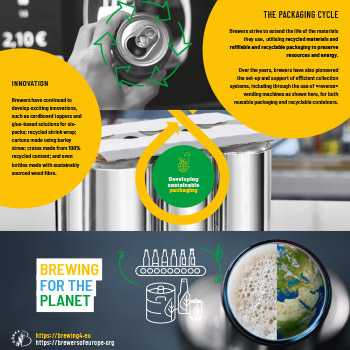
Packaging infographic

 Discover how brewers are working to reduce, reuse and recycle beer packaging

  • 14/03/2023
  • advocate
  • PPWR,Packaging,Cans,Kegs,bottles,sustainability

The registration for the Brewers Forum 2023 opens today!

The registration for the Brewers Forum 2023 opens today! Join us in Prague, Czech Republic, from the 21st to the 24th of May for four days of conferences, trade show, social events technical visits and amazing networking!

  • 28/02/2023
  • news

DETERMINATION OF GLUTEN IN BEER USING THE R5 COMPETITIVE ELISA METHOD (IM)

It is imperative that those who are sensitive to gluten can be confident consuming foods that are labelled gluten-free or that are naturally gluten-free. The only process capable of ensuring that a product is 100% gluten-free is to utilize 100% gluten-free grains. For beer that is rendered gluten-free, the competitive R5 ELISA method is capable of detecting hydrolysed prolamins that remain in beer. The prescribed determination of gluten in beer is using RIDASCREEN® Gliadin competitive kit. This method is equivalent to the ASBC Method of Analysis Beer-49. According to the AOECS standard for gluten-free foods, the R5-competitive ELISA should always be applied to fermented and partly hydrolysed products like beer.

  • 11/01/2023

Just published - BrewUp Magazine’ 4th edition!

The 4th issue of BrewUp Magazine, The Brewers of Europe’s bi-annual publication for brewers by brewers, is now available online on BrewUp . Have a look and find out what’s brewing in Europe! 

  • 15/11/2022
  • news