Guidance on nutrition claims
This Guidance is designed to assist breweries in implementing EU legislation on nutrition claims as provided for by Regulation 1924/2006/EC.
- 25/12/2011
- market
This Guidance is designed to assist breweries in implementing EU legislation on nutrition claims as provided for by Regulation 1924/2006/EC.
The Beer Image Tracker study 2016 provides for useful insights on beer perception throughout different European Union countries.
The Love Beer website, whose access is restricted to members of The Brewers of Europe, offers tools that can be activated against a set of rules in order to promote the beer category at national level. Access request to Love-Beer.eu
This document provides for an overview of the advertising regulation applying to beer, wine and spirits in the 28 European Union Countries as well as Turkey, Norway and Switzerland. It covers TV, radio, outdoor, online, cinema and stadium advertising.
This table presents an overview of the national legal purchasing and drinking age for beer, wine and spirits across the 28 European Union Countries and Turkey, Norway and Switzerland
This toolkit has been developed jointly by The Brewers of Europe and the European Brewery Convention (EBC) and aims at helping brewers to determine the nutritional values of their beers in order to share:
The toolkit has been designed to draw brewers' attention to available methods that would help them to calculate the nutritional values of their beer. It contains references to existing (and publicly available) methods and also advice on how they are able to deduce or calculate the data based on data available.
That study focuses on the economic impact of high excise duties and/or the changes in excise duty implemented by national governments.
This report provides an analysis of European consumers’ information needs and preferences regarding alcoholic beverages. The results show that whilst consumers’ knowledge of the nutritional value and ingredient information of alcoholic beverages is very limited, there is interest to receive this kind of information, and an interest in accessing it through off-label channels such as websites and applications.
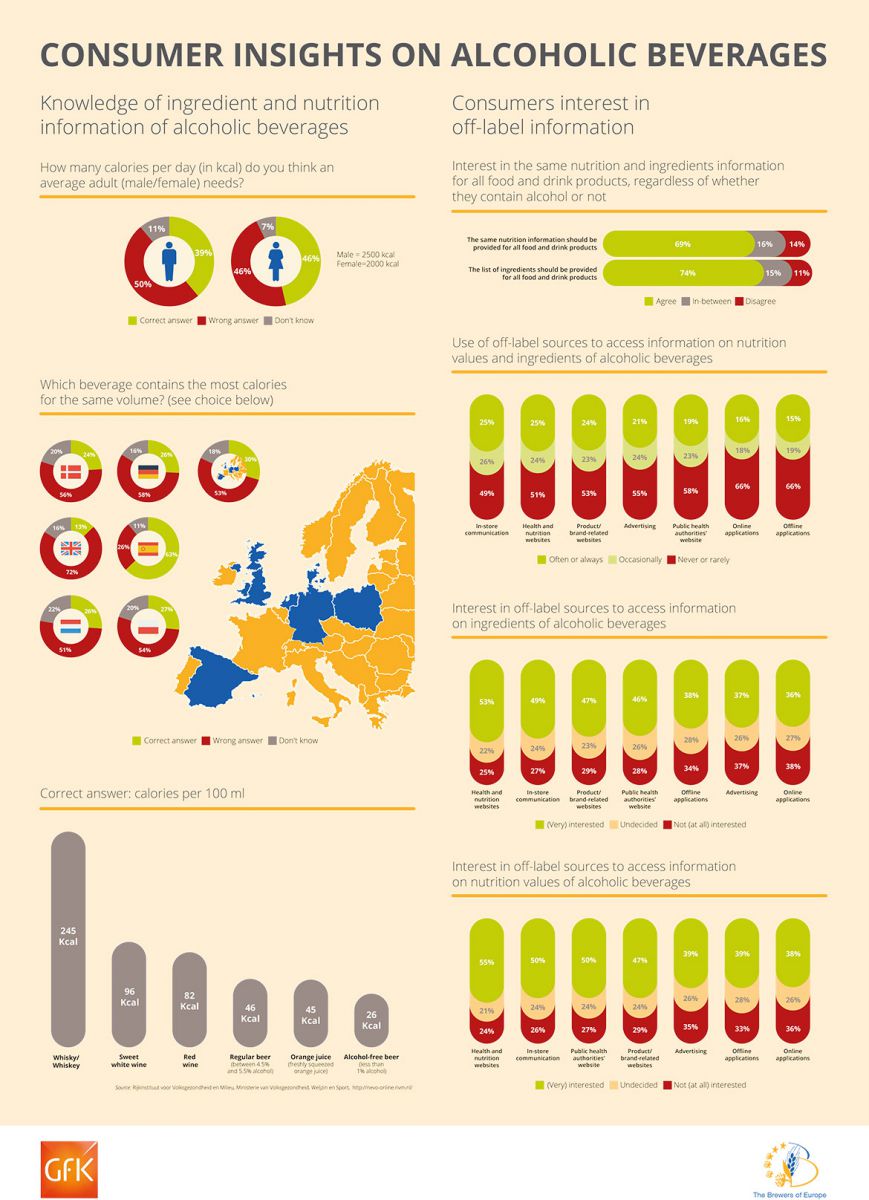
This Infographic sums up at a glance the most striking findings from the GfK report “Consumer Insights: Knowledge of Ingredient and Nutrition Information of Alcoholic Beverages, Off-Label Information and its Use”.
This Guidance is designed to assist breweries in providing the nutrition declaration for their beers (mandatory for beers up to 1.2% abv and voluntary for beers of more than 1.2% abv) as laid down in the Food Information to Consumers Regulation (Regulation (EU)1169/2011) that applies throughout the European Union.
This Toolkit has been designed to help trade associations at national level, brewers and any stakeholders wishing to team-up to prevent drink-driving. It provides for structural and practical advice and best-practices and builds upon concrete examples of actions that have been run or are still run on the ground to prevent drink-driving.
This Toolkit has been designed to help trade associations at national level, brewers and any stakeholders wishing to team-up to inform consumers about drinking and pregnancy. It provides for structural and practical advice and best-practices and builds upon concrete examples of actions that have been run or are still run on the ground to inform consumers about drinking and pregnancy.
This Toolkit has been designed to help trade associations at national level, brewers and any stakeholders wishing to team-up to prevent underage drinking. It provides for structural and practical advice and best-practices and builds upon concrete examples of actions that have been run or are still run on the ground to prevent underage
This Toolkit has been designed to help trade associations at national level, brewers and any stakeholders wishing to team-up to prevent binge drinking. It provides for structural and practical advice and best-practices and builds upon concrete examples of actions that have been run or are still run on the ground to prevent drink driving.
This report presents the changes and trends in the environmental performance in the key areas over the years 2008 to 2010. This quantitative data is supported and illustrated by a selection of prominent case studies.
This report measures the extent to which brewers of all sizes, across Europe, contribute to supporting the local communities through the sponsorship of different projects in different fields such as sports, culture, art…
This is the report on The Brewers of Europe’s commitment on self-regulation of commercial communications for beer, as submitted to the European Alcohol and Health Forum in 2007.
This study addresses the diversity in approaches to sustainable water management by providing further clarity to the Brewers Environmental Resources Management 2 Project 0157302 - The Brewers of Europe of Europe on the most applicable and relevant water stress identification and assessment tools and methodologies for the brewery sector. The purpose is to equip Brewers with the knowledge and understanding of the tools currently available to assess effective and potential water risks now and in the futures and that meet the needs of individual companies. The tools and methodologies reviewed focus on evaluating risks of production facilities (and not the supply chain e.g. agriculture).
This is the first interim report on the implementation of The Brewers of Europe’s commitments to the European Alcohol and Health Forum. It covers the first two commitment waves, made in December 2007 and July 2008, and offers the reader an overview of the background, baseline, progress and next steps in relation to the 25 commitments so far filed.
In this report, commissioned by The Brewers of Europe, the Swedish Retail Institute, HUI, has analysed the success and failures of Swedish alcohol policy. The Swedish Retail Institute, HUI, was founded in 1968 and is owned by The Swedish Trade Federation. HUI conducts its research activity together with several external researchers and in cooperation with a number of Swedish universities. HUI is well-known in the Swedish society for its seriousity, integrity and independence